
Your Position>:homepage ACADEMIC ACADEMIC ACTIVITIES
ACADEMIC ACTIVITIES
Huzhou University Faculty and Students Publish Paper in Nature’s Sub-Journal Molecular Psychiatry
[作者]: [来源]:School of Medicine and Nursing [时间]:2026-04-03 16:22:15 [阅读次数]:11A systematic review and meta-analysis on lifetime prevalence of schizophrenia,which has been the largest scale study globally heretofore, was Recently conducted by a team from Huzhou university. Zhang Shuxin, a graduate student from Huzhou University’s School of Medicine and Nursing, under the supervision of Professor Zhou Yuqiu, led the team to probe into lifetime prevalence of schizophrenia, which is now a crucial public health concern. The academic paper, titled Global lifetime prevalence of schizophrenia: A systematic review and meta-analysis, was published in Molecular Psychiatry, a Nature sub-journal ,with Zhang as the first author, Professor Zhou the corresponding author and Huzhou University the first affiliation.
This breakthrough, not merely a reflection of capabilities of the student researcher, is a snapshot of the coordinated efforts across many work areas: student affairs, disciplinary development, academic construction and talent cultivation at both the university and school levels, highlighting the University’s edge in the deeper-level integration of foundational research and evidence-based practice in the field of mental health.
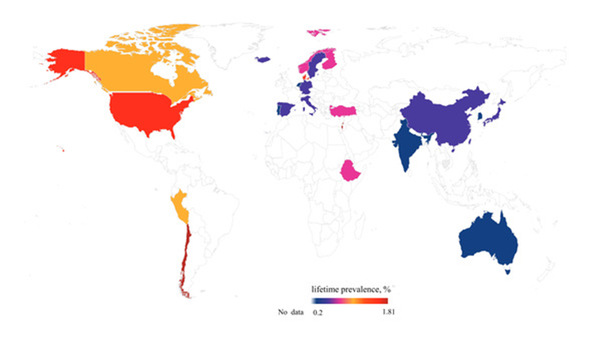
Altogether 109 publications were cited in the study, covering over 20.91 million individuals from the general population across 24 countries, as well as various special groups such as homeless individuals, prisoners, people with comorbid conditions, and those with high genetic risk,composing an unprecedentedly vast sample database. Key findings include: (1) Lifetime prevalence in the general population: Based on 60 studies, the global lifetime prevalence of schizophrenia in the general population is 0.62% (95% CI: 0.51%–0.76%), with the lowest rate in Asia (0.47%) and the highest in South America (1.55%). (2) Homeless population: Drawing on 21 studies, the lifetime prevalence among homeless individuals is 10.02% (95% CI: 7.38%–13.47%), approximately 16 times that of the general population. This reveals a significant bidirectional relationship between schizophrenia and homelessness — schizophrenia increases the risk of homelessness by impairing social functioning, while homelessness exacerbates psychotic symptoms through social isolation, substance abuse, and lack of access to medical care. (3) High genetic risk and other special populations: 4.40% lifetime prevalence for individuals with high genetic risk, 3.76% for those with comorbid psychiatric disorders, 3.14% for incarcerated individuals, 1.49% for low-income populations, 1.47% for those with comorbid physical illnesses, 1.17% for indigenous populations, and 1.09% for individuals exposed to trauma or stress. Each of these special groups has a significantly higher prevalence than the general population, ranging from 1.5 to 14 times higher. (4) Demographic and methodological factors: Prevalence rates in Asian regions are the lowest for both the general and homeless populations. Married individuals have a lower lifetime prevalence (0.36%) than unmarried individuals (0.84%). Populations with an average age of 40 years or older show a higher prevalence (1.15%), consistent with the cumulative nature of lifetime prevalence.
Findings indicate that schizophrenia can occur in all populations, but the lifetime prevalence is significantly higher among special groups due to multiple factors. The findings support a bio-psycho-social integrative framework, in which the interaction between genetic susceptibility and environmental adversity determines the risk of schizophrenia. Marginalized groups bear a disproportionate burden of the disease. The results provide important scientific evidence for the development of targeted prevention strategies, the advancement of early intervention, and the formulation of culturally sensitive regional mental health policies.
This study was completed through a collaboration between Huzhou University’s School of Medicine and Nursing, the School of Nursing of Harbin Medical University, and the Nursing Department of Haining Fourth People’s Hospital in Jiaxing. The team comprises Zhang Shuxin, Chen Yubin, Zhang Linghui, Yang Xinyu, Dong Junhui, Lu Minle, Zhou Na, Feng Yang, Zhang Yu, and Zhou Yuqiu. The research is supported by the National Natural Science Foundation of China (Grant No. 72074063).
Paper link: https://doi.org/10.1038/s41380-026-03533-3


Address: No. 759, East 2nd Road, Huzhou, China(313000)
telephone: 0572-2322746 technical support: Pioneer