
Your Position>:homepage ACADEMIC ACADEMIC ACTIVITIES
ACADEMIC ACTIVITIES
Scholars from Huzhou University Publishes Research in Nature Communications
[作者]: [来源]:School of Sciences [时间]:2025-12-17 9:49:10 [阅读次数]:11Recently, Professor Robert’s team from Huzhou University, in collaboration with the research team from the University of Johannesburg, South Africa, discovered a rich and previously unknown topological structure within entangled photons using only the orbital angular momentum (OAM) of light. The team established skyrmions composed of purely OAM-entangled light and demonstrated a direct correspondence with the non-Abelian monopole textures in high-energy physics, further proposing a scalable high-dimensional quantum state “topological spectrum.” These findings were published in Nature Communications under the title “Revealing the topological nature of entangled orbital angular momentum states of light”, with Professor Robert Shawn de Mello Koch as the first author and Huzhou University listed as the first affiliation.
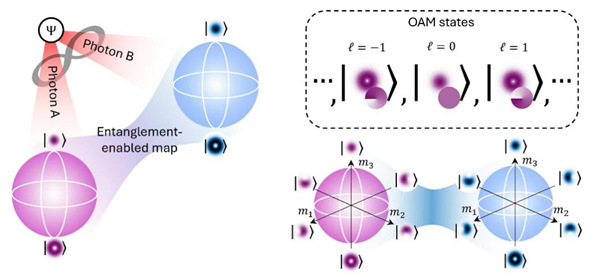
This work shows that topology can be regarded as an intrinsic property of entanglement rather than a simulated effect, opening new avenues for more robust quantum communication, quantum sensing, and quantum computing. Because the method relies solely on OAM without requiring prior polarization, it is broadly compatible with existing structured-light platforms and can be extended to higher dimensions.
Professor Robert stated: “The exciting aspect is that the topology we observed is not artificially designed—it already exists within the entangled state. By directly revealing and measuring it, we link tabletop optical experiments with the mathematical theories of monopoles and Higgs fields, while creating new resources for high-dimensional quantum technologies.” Professor Andrew Forbes from the University of Johannesburg added: “Using only OAM, we have surpassed the conventional polarization paradigm. The resulting topological spectrum grows explosively with dimension, providing a large-scale and noise-resilient high-dimensional quantum alphabet for quantum information.”
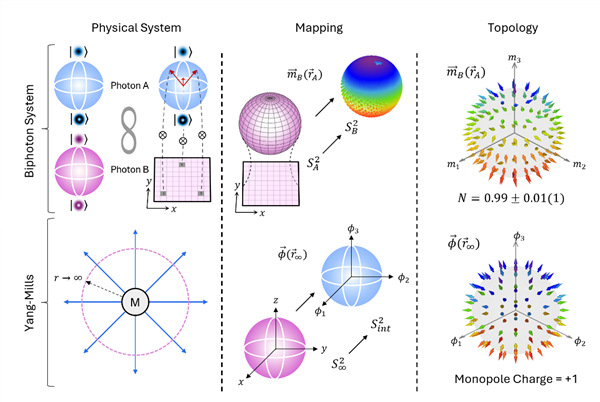
The key findings include:
1.The first OAM-based skyrmions: The team created and measured skyrmion/anti-skyrmion mappings between two OAM “spheres” defined by entanglement.
2.Two-photon–monopole correspondence: The same mapping corresponds to the asymptotic Higgs field texture of the ’t Hooft–Polyakov monopole, connecting optical measurements with the foundations of gauge theory.
3.High-dimensional “topological spectrum”: In dimensions 3, 5, and 7, different embedded submanifolds organized by SU(d) carry distinct winding numbers, generating thousands of candidate invariants as d increases.
4.Robust yet sensitive: Nontrivial features persist under realistic noise, and new features can be intentionally induced in previously trivial subspaces, offering both noise resilience and channel diagnostics.
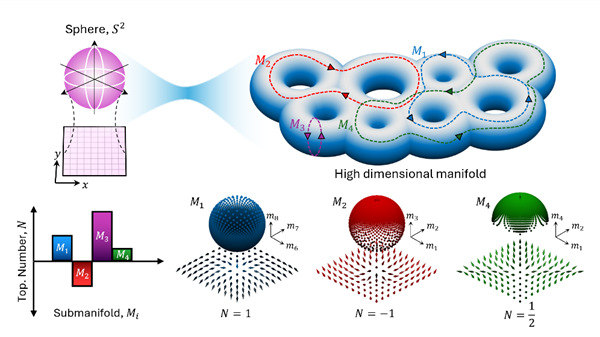
This study has significant application value. High-dimensional entanglement is a key frontier for achieving secure quantum communication and advanced quantum sensing, and the topological description provides two main advantages: stability (topological features are robust to small perturbations) and scalability (the available “alphabet” grows rapidly with dimension). The study offers a direct, experiment-based framework for measuring, certifying, and utilizing such topological features.
This project was completed through collaboration between Huzhou University and the structured-light team at the University of Johannesburg. Team members include Robert, Pedro Ornelas, Neelan Gounden, Lu Boqiang, Isaac Nape, and Andrew Forbes.
Article link: https://www.nature.com/articles/s41467-025-66066-3.pdf


Address: No. 759, East 2nd Road, Huzhou, China(313000)
telephone: 0572-2322746 technical support: Pioneer