
Huzhou University Convenes Special Training Session on Educational Internationalization
[作者]: [来源]: International Exchanges and Cooperation Office [时间]:2025-11-24 9:13:00 [阅读次数]:17To systematically review the outcomes and experience of educational internationalization during the “14th Five-Year Plan” period and to comprehensively plan a new blueprint for international development in the “15th Five-Year Plan” period, Huzhou University held a special training session on educational internationalization on November 20. Vice President Li Qingfeng attended the meeting and delivered a speech. Heads of the Publicity Department, Human Resources Department, Student Affairs Office, Graduate School, Academic Affairs Office, Science and Technology Department, Humanities and Social Sciences Department, and the Office of Social Cooperation and Development Liaison, as well as leaders of secondary schools, deputy Party secretaries in charge of student work, and staff engaged in international affairs participated in the session.
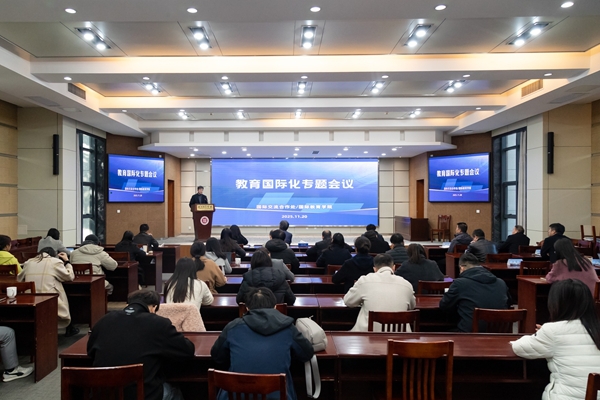
At the meeting, the head of the Office of International Cooperation and Exchange / School of International Education delivered a report on work review and future plans. The report provided a comprehensive overview of the achievements since the beginning of the “14th Five-Year Plan” in such areas as expanding the global cooperation network, promoting international mobility of faculty and students, and enhancing the training system for international students. It also analyzed the current challenges and outlined development approaches and key tasks for the “15th Five-Year Plan” period.
In his speech, Li Qingfeng elaborated on the strategic significance of educational internationalization in the context of the new era. He emphasized that educational internationalization has been clearly identified as one of the six core strategies in the University’s “163” development framework and as one of the ten special plans in the “15th Five-Year Plan”. It serves as a strong driving force for advancing discipline development, faculty development, talent cultivation, and scientific research. Educational internationalization, he noted, is closely linked to the University’s reputation, academic influence, and ability to attract high-quality students, and represents a “must-answer question” on the path toward high-quality development. It must therefore be closely integrated with management and services, teaching and research, and student cultivation, forming a mutually reinforcing whole. In his remarks, he stressed that educational internationalization must be advanced in step with the strategic goals of high-quality development and innovation-driven growth. He outlined five key priorities: strengthening a university-wide governance system for internationalization and integrating it into the daily work of all units; enhancing the faculty team to build a corps of teachers with global vision and strong teaching competence; focusing on talent cultivation to nurture graduates with global competitiveness; deepening scientific research by reinforcing international research cooperation and exchange; and optimizing support systems to foster an enabling environment for internationalized development. He emphasized that, in formulating the “15th Five-Year Plan” and the related special plans, internationalization must be treated as a core element and planned and designed in parallel, so as to elevate educational internationalization at Huzhou University to a new level.
The meeting specially invited Mao Xilong, Director of the Office of International Cooperation and Exchange at Zhejiang Normal University, to deliver a keynote report entitled “Leveraging the Advantages of International Cooperation to Serve the University’s Central Tasks”.
In his report, Mao Xilong gave a detailed introduction to Zhejiang Normal University’s concrete practices and notable achievements in areas such as international student recruitment and education, overseas exchanges and cooperation for faculty, international scientific research collaboration, and Chinese-foreign cooperative education. He pointed out that the internationalization of higher education is not limited to recruiting international students or organizing international exchange activities; more importantly, it lies in embedding the concept of internationalization into all aspects of talent cultivation, discipline development, and scientific research, thereby forming an all-round, multi-level, and broad-based international education framework. In addition, he shared Zhejiang Normal University’s strategies for addressing challenges encountered in the process of educational internationalization, providing valuable reference for Huzhou University.
This training session helped unify thinking, clarify direction, and build consensus. It laid a solid foundation for Huzhou University, at a new starting point, to promote a profound shift in educational internationalization—from merely “handling tasks” to strategic “planning initiatives”, and from a “passive” stance to a “proactive” approach. Going forward, Huzhou University will continue to deepen high-level educational opening-up and promote the high-quality development of its various undertakings.


Address: No. 759, East 2nd Road, Huzhou, China(313000)
telephone: 0572-2322746 technical support: Pioneer