
Your Position>:homepage ACADEMIC ACADEMIC ACTIVITIES
ACADEMIC ACTIVITIES
Faculty Members from School of Engineering Published Research Paper in Journal Journal of Colloid and Interface Science
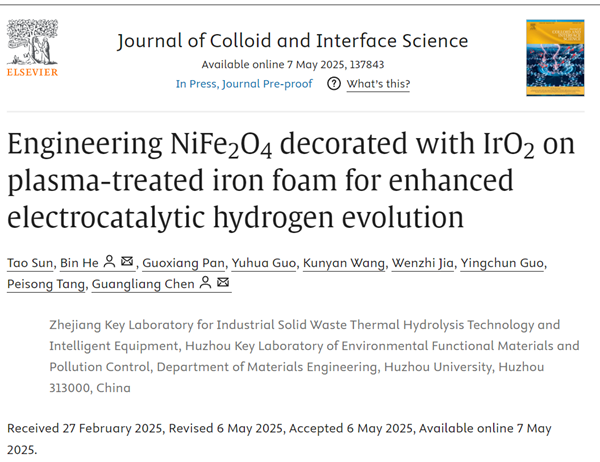
[作者]: [来源]:Office of Scientific Research and School of Engineering [时间]:2025-05-14 14:50:53 [阅读次数]:10Recently, Associate Professor Bin He and Professor Guangliang Chen from the Department of Materials Science and Engineering at Huzhou University’s School of Engineering published a research article titled “Engineering NiFe2O4 decorated with IrO2 on plasma-treated iron foam for enhanced electrocatalytic hydrogen evolution” in the prestigious chemistry journal Journal of Colloid and Interface Science (CAS Zone 1 TOP journal, IF: 9.4), with Huzhou University listed as the first affiliation.
Hydrogen (H2) is regarded as one of the major environmentally friendly renewable energy sources for the future. Among various hydrogen production methods, the electrocatalytic hydrogen evolution reaction (HER) is a promising strategy for obtaining H2 from water. In practice, the HER process in alkaline media involves two steps, where the kinetics are primarily determined by the trade-off between water dissociation and hydrogen generation. The large overpotential and sluggish kinetics of electrocatalysts severely limit electrolysis efficiency. Therefore, there is an urgent need to design highly efficient, low-cost HER electrocatalysts to support China’s efforts to achieve its dual carbon goals.
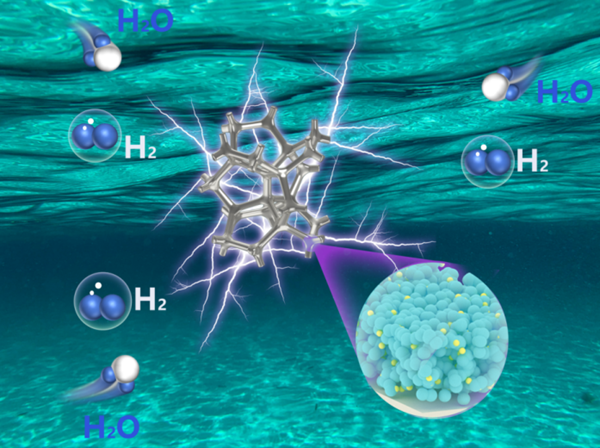
This study introduces a highly frequent plasma-assisted strategy for fabricating heterostructured electrocatalysts, addressing the persistent challenges in developing efficient HER systems, and a highly efficient and durable NiFe2O4-IrO2 electrocatalyst was successfully synthesized on a dielectric barrier discharge (DBD) plasma-treated iron foam (PFF) substrate. This PFF substrate exhibits critical advantages, including a 3D hierarchical structure that promotes electrolyte penetration, strong interfacial binding energy, and accelerated gas evolution kinetics. The optimized NiFe2O4-IrO2/PFF demonstrates outstanding HER performance, achieving overpotentials of 24 mV, 222 mV, and 310 mV at current densities of 10 mA cm-2, 100 mA cm-2, and 300 mA cm-2, respectively, surpassing most reported iron-based catalysts. Additionally, the catalyst exhibits exceptional stability, for it had maintained activity for 100 hours at 10 mA cm-2. Furthermore, density functional theory (DFT) calculations reveal that the synergistic effects between NiFe2O4 and IrO2 on the PFF substrate contribute to the superior HER performance. This research provides an effective strategy for developing highly active electrocatalysts and offers a promising pathway for advancing HER technology.
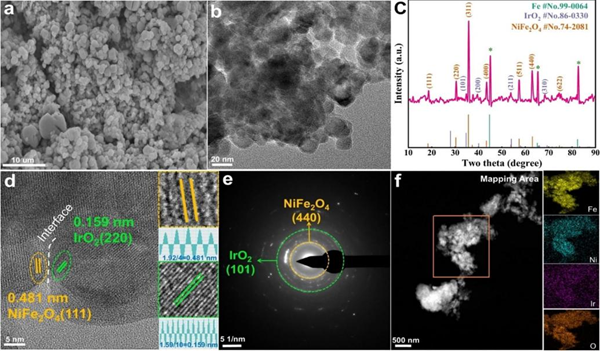
The results above validate that the outstanding catalytic activity of NiFe2O4-IrO2/PFF can be attributed to several key factors. First, the DBD plasma treatment significantly enhances the binding strength between the iron foam and the catalyst, ensuring electrocatalytic stability. Second, the synergy between NiFe2O4 and IrO2 provides abundant active sites, improving intrinsic catalytic activity. Finally, the introduction of oxygen vacancies reduces charge transfer resistance, enhancing electrocatalytic reaction kinetics. This work proposes a novel and universally applicable approach for developing high-performance, low-cost transition metal-based electrocatalytic electrode materials.
Link to the paper:
https://www.sciencedirect.com/science/article/pii/S0021979725012342


Address: No. 759, East 2nd Road, Huzhou, China(313000)
telephone: 0572-2322746 technical support: Pioneer