
Academic Seminar on “Implementing the ‘Two Mountains’ Concept and Building a Beautiful China” and the Sixth Council Meeting of the First Session of the “Two Mountains” Think Tank Alliance Held at Huzhou University
[作者]: [来源]:Institute for Sustainable Development [时间]:2025-03-24 9:17:28 [阅读次数]:112025 marks the 20th anniversary of the proposal of the concept “Lucid waters and lush mountains are invaluable assets.” To further implement this concept, support the construction of a Beautiful China, deepen the study and dissemination of Xi Jinping’s Thought on Ecological Civilization, and better tell the “Two Mountains” story, the academic seminar on “Implementing the ‘Two Mountains’ Concept and Building a Beautiful China,” along with the sixth council meeting of the first session of the “Two Mountains” Think Tank Alliance, was held on March 22 at Huzhou University.
The event was co-hosted by Huzhou University and the “Two Mountains” Think Tank Alliance, and co-organized by the Research Institute for the “Two Mountains” Concept at Huzhou University, the Huzhou Research Base of the Zhejiang Provincial Center for the Study of Xi Jinping Thought on Socialism with Chinese Characteristics for a New Era, and the Yangtze River Delta Forestry Innovation Alliance for Common Prosperity (in preparation) under the National Forestry and Grassland Administration.
Distinguished attendees included Huang Jian, Deputy Director of the Publicity and Education Center of the Ministry of Natural Resources; Liu Qingsong, Vice President of the Chinese Society for Ecological Civilization and Chairman of the “Two Mountains” Think Tank Alliance; Jin Peihua, former Party Secretary of Huzhou University, Executive Director of the Alliance, and Vice President of the Chinese Ecological Economics Society; Shu Zhiding, Vice President of Huzhou University; Xie Zhanqiang, Deputy Head of the Publicity Department of the CPC Huzhou Municipal Committee and Chairman of the Huzhou Federation of Social Sciences; and Hu Kanping, Director of the Research Department and Chief Expert at the Chinese Society for Ecological Civilization.
More than 60 representatives from over 20 organizations attended the conference, including the Ministry of Natural Resources, the Ministry of Ecology and Environment, the Chinese Society for Ecological Civilization, Peking University, Tsinghua University, Zhejiang University, Beijing Forestry University, Beijing National Accounting Institute, Jiaxing University, the Sichuan Institute of Environmental Policy Research and Planning, the Guangdong Academy of Environmental Science, the Huzhou Federation of Social Sciences, the Zhejiang Ecological Civilization Cadre Institute, the Shandong Institute of Ecological Civilization, the Enshi Municipal Party School, the Yangtze River Economic Belt Strategy Research Institute at Hubei University of Economics, the Guangdong Environmental Restoration Industry Technology Innovation Alliance, China Siwei Surveying and Mapping Technology Co., Ltd., Gannan Gaowenda Animal Husbandry Co., Ltd., Tianneng Holding Group Co., Ltd., as well as Huzhou University, the “Two Mountains” Think Tank Alliance, and the Yangtze River Delta Forestry Alliance for Common Prosperity.
Themed “Implementing the ‘Two Mountains’ Concept and Building a Beautiful China,” the seminar featured in-depth discussions among experts on topics such as ecological civilization, the “Thousand Villages Demonstration, Ten Thousand Villages Renovation” project, building a Beautiful China, translating the “Two Mountains” concept into practice, beautiful countryside construction, and agricultural cultural heritage. The seminar was chaired successively by Jin Peihua, Liu Qingsong, and Hu Kanping.
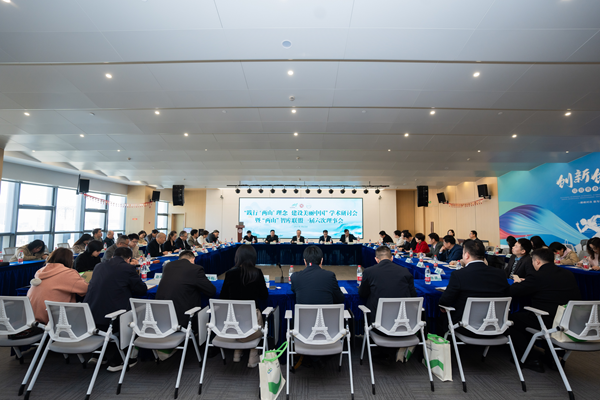
In his welcome address, Vice President Shu Zhiding expressed heartfelt appreciation to all attending experts and scholars and gave a brief overview of the university’s development. He highlighted the key role the “Two Mountains” Research Institute has played in advancing the theoretical interpretation of Xi Jinping Thought on Socialism with Chinese Characteristics for a New Era. He noted that the topics of the conference—such as the realization of the value of ecological products, beautiful countryside development, and the broader Beautiful China initiative—are significant theoretical and practical issues in China’s modernization process. He emphasized that Huzhou and Zhejiang have generated abundant real-world experiences that offer valuable models for high-quality development and common prosperity. He also expressed his hope that the scholars would contribute fresh ideas and help nurture high-caliber theoretical talent.
Huang Jian commended the alliance for its achievements over the past three years in pooling resources, conducting systematic and theoretical research, summarizing practical local case studies, and producing influential scholarly outputs. These contributions, he said, have promoted Xi Jinping’s ecological civilization thought globally and supported high-quality economic development. He also offered several constructive suggestions for the alliance’s future: First, to enhance the integration of research outcomes; second, to expand horizontal cooperation among member institutions. He announced the launch of the second essay competition on Xi Jinping’s Thought on Ecological Civilization, with the theme: “Lucid Waters and Lush Mountains Are Invaluable Assets.”
Xie Zhanqiang extended warm greetings and appreciation to the visiting experts and scholars. He expressed the hope that the “Two Mountains” Think Tank Alliance would contribute wisdom and strength to Huzhou’s goal of becoming a model city for ecological civilization. He also welcomed alliance members to participate in a research initiative via high-speed rail, commemorating the 20th anniversary of the “Two Mountains” concept, and looked forward to the successful convening of the “Two Mountains” Forum later this year.
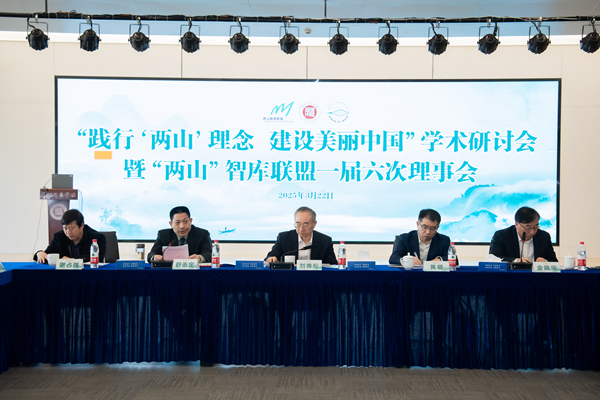
In the keynote session, Professor Jin Peihua from Huzhou University and Researcher Wang Xianpeng from the Peking University Institute for Xi Jinping Thought delivered presentations titled “The Anji Practice in Building a Beautiful Countryside in China” and “The Philosophical Foundation of the New Ecological Civilization,” respectively.
In the thematic sessions, reports included:
Prof. Ye Yanmei (Zhejiang University): “Comprehensive Land Consolidation for Rural Revitalization and Urban-Rural Integration”
Prof. Zheng Hongtao (Beijing National Accounting Institute): “Financial and Policy Effects and Innovation in the Bamboo Industry”
Prof. Qin Zunwen (Yangtze River Economic Belt Think Tank Alliance): “Promoting New-Type Urbanization through Integrated Yangtze River Basin Governance”
Director Zhang Xiuyu (Guangdong Academy of Environmental Science): “Accelerating the Value Transformation of Ecological Products in the Fourth Industry”
Prof. Zhang Jianguo (Huzhou University): “Empowering Rural Revitalization through Agricultural Cultural Heritage: The Zhejiang Practice”
Prof. Gu Huashan (Jiaxing University): “From the ‘Ten Thousand Villages’ Project to Beautiful Countryside: Experience and Insights from Zhejiang”
Researcher Sun Ning (Ministry of Ecology and Environment): “Framework for Major Ecological and Environmental Projects Toward a Beautiful China”
Prof. Wang Hailong (Guangdong Biochar Engineering Technology Center): “Biochar Negative Carbon Technologies Supporting Beautiful China”
Wei Zhiguo (Vice Mayor of Mengyin County, Shandong): “Thoroughly Implementing the ‘Two Mountains’ Concept and Writing a New Chapter of the ‘Peach Blossom Spring’”
Du Jinhua (Dongying Party School): “Turning the Yellow River Estuary into a New Landscape of the ‘Two Mountains’ Concept”
Zhang Min (China Siwei): “Smart Environmental Services by China Siwei”
The presentations combined rich real-world case studies with in-depth academic analysis, making this seminar a high-level “thinking forum” and a high-quality “brainstorming session.”
During the event, the sixth council meeting of the first session of the “Two Mountains” Think Tank Alliance was also held, and new member institutions were officially inducted. Secretary-General Yang Jianchu reported on the alliance’s recent work, and the council approved the addition of four new member units: the Institute for Green Development at Tianjin University, the Institute for Common Prosperity at Jiaxing University, the Zhejiang Ecological Civilization Cadre Institute, and the Guangdong Biochar Engineering Technology Center.
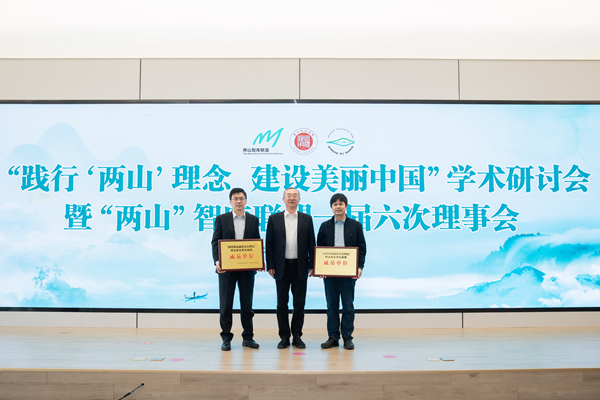
In his remarks, Liu Qingsong, Chairman of the “Two Mountains” Think Tank Alliance, emphasized that the alliance has remained committed to promoting ecological civilization since its establishment. It has brought together three international think tanks and 28 domestic institutions, creating a powerful force for promoting the “Two Mountains” concept through theoretical research, policy consultation, and practical exploration. The inclusion of new members injects fresh vitality and expands the alliance’s development potential. Liu stated that the 20th anniversary of the concept presents an important opportunity to deepen theoretical studies, strengthen practical exploration, and enhance international collaboration—contributing Chinese wisdom, solutions, and strength to building a community of life on Earth and a clean, beautiful world.
The “Lucid Waters and Lush Mountains Are Invaluable Assets” Think Tank Alliance, abbreviated as the “Two Mountains” Think Tank Alliance, is a non-legal academic organization initiated by the Research Institute for the “Two Mountains” Concept at Huzhou University—where the concept was first proposed and implemented. The alliance is jointly established by domestic and international institutions, enterprises, and organizations engaged in green development, environmental protection, ecological civilization, biodiversity, and sustainable development.
As of 2025, the alliance comprises 31 well-known think tanks and institutions, including the Sharaf Foundation for Sustainable Development (Egypt), the China-U.S. Postmodern Development Institute, Peking University, Tsinghua University, and Zhejiang University. The alliance is committed to studying the “Two Mountains” concept, planning for green development, serving ecological civilization, and promoting common prosperity. It focuses on major theoretical and practical issues in ecological civilization and green development, and engages in joint research, policy advice, social service, talent development, and international exchange—striving to build a new type of high-end think tank alliance with Chinese characteristics and global influence.


Address: No. 759, East 2nd Road, Huzhou, China(313000)
telephone: 0572-2322746 technical support: Pioneer